
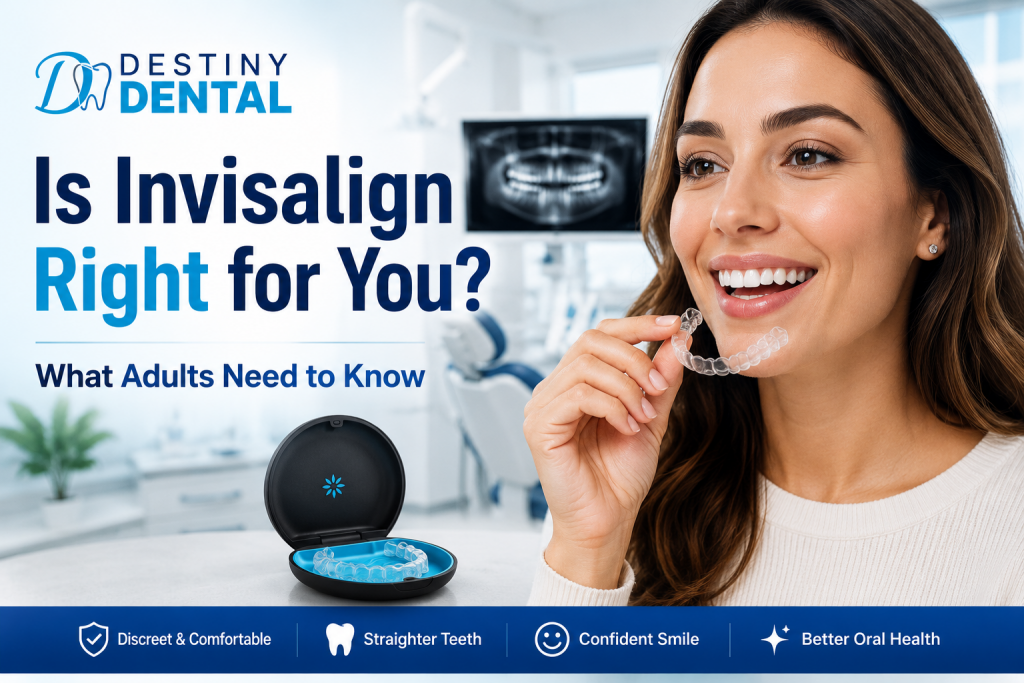
More adults are straightening their teeth than at any point in the history of dentistry, and a significant reason for that is Invisalign. The idea of wearing braces as an adult is off-putting for most people, but Invisalign offers a different experience that fits more naturally into adult life. Whether it is the right option for you depends on your specific situation.
This guide explains what Invisalign is, how the treatment works, who makes a good candidate, what it actually costs, and what to expect throughout the process.
What Is Invisalign?
Invisalign is a system of clear, removable plastic aligners that gradually shift your teeth into a desired position. Each aligner is custom-fabricated using a digital scan or impression of your teeth, and each one in the series is slightly different from the last, applying gentle, controlled pressure to move teeth incrementally.
The aligners are made from a proprietary thermoplastic material and are designed to be nearly invisible when worn. For adults self-conscious about the idea of metal brackets and wires, this is the most significant practical advantage. Invisalign is not a single product but a treatment system administered by a trained dental provider who designs and monitors your treatment plan from start to finish.
Invisalign How Does It Work?
Understanding how Invisalign works helps set realistic expectations for the experience.
Digital planning. The process begins with a detailed scan of your teeth, typically using an intraoral scanner rather than traditional impression materials. This creates a precise 3D digital model of your current dental position, which your dentist uses with specialized software to plan the entire tooth movement sequence before a single aligner is made.
Custom aligner fabrication. Based on the treatment plan, a full series of aligners is manufactured, each representing a specific step in the movement sequence. A typical full treatment involves between 20 and 50 sets of aligners, though simpler cases may use fewer.
Wearing and progressing. You wear each aligner for approximately one to two weeks before moving to the next in the sequence. The aligners must be worn for 20 to 22 hours per day to be effective, with the remaining time for eating, drinking anything other than water, and brushing.
Progress appointments. You visit your dentist every six to eight weeks for progress checks and to receive your next series of aligners.
Attachments. Many treatments involve small tooth-colored dots bonded to specific teeth, called attachments, that give the aligners something to grip for more complex tooth movements. They are not always necessary for simpler cases.
Retainers. After treatment is complete, you wear retainers to hold your teeth in their new positions, since teeth have a natural tendency to drift back toward their original position.
Who Is a Good Candidate for Invisalign?
Invisalign treatment can address a wide range of orthodontic conditions in adults, including mild to moderate crowding, spacing between teeth, overbite, underbite, crossbite, open bite in many cases, and relapse from previous orthodontic treatment.
Good candidates are adults or older teenagers with fully erupted permanent teeth, healthy gums and bone structure, and the discipline to wear the aligners consistently. Patients who frequently forget to put aligners back in after meals will not achieve the planned result on schedule.
Less suitable candidates include patients with severe malocclusions requiring significant movement in multiple planes, those needing significant vertical tooth movement or rotations that respond poorly to aligner treatment, and patients with severe bone loss from gum disease that would make tooth movement risky. The only reliable way to determine candidacy is a clinical examination and digital records.
Invisalign vs. Traditional Braces: Key Differences
Invisalign aligners are nearly invisible to most observers in normal social situations, while traditional braces are visible metal brackets and wires. For adult patients in professional environments, this is often the deciding factor.
Invisalign aligners come out for eating, drinking, and oral hygiene, which means you can eat anything you want. With braces, you cannot eat sticky or hard foods, and oral hygiene around the brackets requires special tools.
Both systems cause some discomfort when new pressure is applied, but aligners cause pressure without the sharp wire ends or bracket irritation that braces can produce. Because aligners are removed for brushing and flossing, maintaining good oral hygiene during treatment is significantly easier than with fixed braces.
Traditional braces work whether you cooperate or not because they are fixed to your teeth. Invisalign requires patient discipline; if aligners are worn fewer than 20 to 22 hours per day, treatment slows or stalls. Traditional braces can treat more severe and complex cases, while Invisalign is appropriate for a broad range of adults but has limitations for the most complex orthodontic situations.
How Long Does Invisalign Treatment Take?
Treatment length varies based on case complexity. Mild cases, such as minor crowding or spacing or minor relapse, typically take 3 to 6 months. Moderate cases take 12 to 18 months. Complex cases can take 18 to 24 months or longer. These timelines assume consistent aligner wear; poor compliance extends treatment significantly.
What Does Invisalign Cost?
Invisalign treatment cost varies based on case complexity and the total number of aligners required. According to industry pricing data, the average comprehensive Invisalign treatment in Ontario runs approximately $5,300, with most patients paying somewhere between $3,000 and $7,000 depending on their specific needs. Shorter, limited treatments addressing minor issues are available at lower cost.
Many dental insurance plans that include orthodontic coverage will apply that benefit to Invisalign treatment, typically up to $1,000 to $2,500 depending on the plan, though coverage amounts vary significantly. Most clinics offer financing options that spread the cost over the treatment period.
What to Expect During Invisalign Treatment
The first week. Aligners feel tight and may cause mild pressure, particularly at the start of a new set. Speech may be slightly affected initially, though most patients adapt within a few days.
Eating and drinking. You remove aligners before eating or drinking anything other than water. Build a habit of removing aligners, eating, brushing, and reinserting.
Aligner care. Rinse aligners with lukewarm water when you remove them; hot water can warp the plastic. Clean them with a soft toothbrush and clear, unscented soap, or Invisalign cleaning crystals.
Aligner storage. Always store aligners in their case when not in your mouth. Many aligners are lost by being wrapped in a napkin or left on a restaurant table.
Progress. You will notice changes in your teeth’s position over the course of treatment, and your dentist reviews progress and makes adjustments as needed at each appointment.
Frequently Asked Questions
What is Invisalign and how does it differ from braces?
Invisalign is a system of clear removable aligners that move teeth gradually. Unlike braces, there are no brackets or wires, aligners are removed for eating, and they are nearly invisible when worn.
Is Invisalign painful?
Most patients experience mild pressure or soreness for the first day or two after switching to a new aligner. This is normal and indicates the aligner is working, and is generally manageable without medication.
Can I drink coffee with Invisalign?
You should remove aligners before drinking coffee. Hot beverages can warp the plastic, and dark liquids can stain the aligners.
How often do I need to see my dentist during Invisalign treatment?
Progress appointments are typically every six to eight weeks. Your dentist monitors tooth movement and provides the next series of aligners.
What happens if I lose an aligner?
Contact your dentist as soon as possible. Depending on where you are in the series, you may be advised to wear the previous aligner until a replacement is made, or to move to the next one.
Summary
Invisalign uses a series of custom clear aligners to straighten teeth gradually without brackets or wires. It works for a wide range of adult orthodontic cases and is particularly well-suited for patients who prioritize appearance and oral hygiene convenience during treatment. Results depend heavily on wearing aligners consistently, and treatment takes anywhere from a few months to two years depending on complexity.
If you are curious about whether Invisalign treatment is right for your teeth, contact us at Destiny Dental to book a consultation with our team.